
Future of Jobs: Why Cognitive Skills Will Shape the Careers of Tomorrow

Your child won’t grow into the same world you did. Their future will unfold in an era shaped by AI, automation and rapid economic change – a reality where tools, jobs, and expectations shift faster than any curriculum can keep up with. The only advantage that endures is the human mind: its capacity to think, adapt, and learn in real time. And in a world where roles evolve overnight, cognitive skills are becoming one of the strongest predictors of future readiness.
If you are raising or teaching children today, you are preparing them for a world that will not resemble the one you entered as an adult. By 2030, their jobs, skills, and daily tools will be shaped by forces moving faster than any previous generation has experienced. They are growing up in an age defined by artificial intelligence, demographic upheavals, economic uncertainty, and global restructuring – all happening at once. And even as future careers continue to shift, the World Economic Forum’s Future of Jobs Report 2025 emphasises a stable insight: cognitive skills will determine how well young people navigate the changes ahead.
Analytical thinking, creativity, resilience, flexibility, agility – these are not buzzwords. They are the core capabilities that employers across 55 global economies say will determine who thrives in the next decade. As millions of jobs disappear and millions more emerge, cognitive skills will act as the anchor that helps the next generation adapt, learn, and reinvent themselves repeatedly.
This article explores the findings of the Future of Jobs Report 2025, explains why cognitive skills are becoming the foundation of the future workforce, and highlights how platforms like CogniFit can help individuals strengthen these abilities in a world where continuous learning is no longer optional.
A Global Workforce Under Transformation
According to the Future of Jobs Report 2025, global labour markets are undergoing one of the most significant transformations in modern history. Between 2025 and 2030, structural labour-market change is expected to affect 22 percent of all existing jobs. Employers anticipate about 170 million new jobs created and 92 million displaced, resulting in a net gain of 78 million roles worldwide. These changes are driven by multiple overlapping forces – technological advancements, economic pressures, demographic shifts, climate-related transitions, and rising geopolitical tensions. The report emphasises that no region or sector will remain untouched.
Yet despite the rapid advancement of AI and automation, the report highlights an important distinction: technology itself is not the primary barrier companies face. The real obstacle is the widening skills gap. Drawing on data from more than 1,000 companies, the report notes that the shortage of qualified talent remains the most serious barrier to business transformation today: nearly 40 percent of the skills required on the job are expected to change, and 63 percent of employers already identify skills gaps as the key challenge ahead. This gap is deepening as industries evolve, underscoring a global need for workers who think critically, solve unpredictable problems, learn quickly, collaborate effectively, and adapt to continuous change.
Cognitive Skills at the Heart of Future Employment
One of the most important insights from the report is the rising value of cognitive and human-centric skills. Even as AI becomes deeply embedded in workplaces, analytical thinking remains the single most essential core skill for 2025 and beyond. It is followed closely by:
- creative thinking;
- leadership and social influence;
- resilience, flexibility, and agility.
The report’s list of fastest-growing skills by 2030 reinforces this trend. Alongside AI and big data, networks and cybersecurity, and technological literacy, cognitive and social-emotional abilities dominate the list:
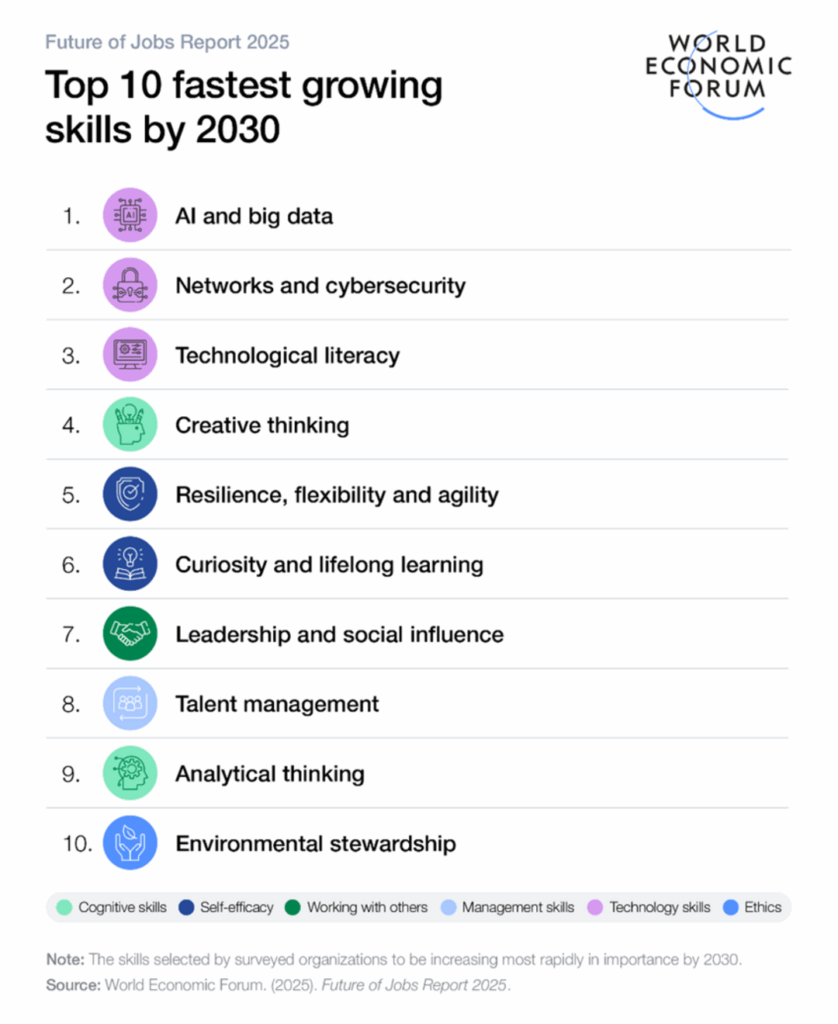
These skills are not tied to a single industry. They define what workers in all sectors will need to navigate environments where tools change rapidly, workflows evolve, and economic structures shift.
The message is consistent across the report: technology skills are necessary, but human cognition will remain irreplaceable.
Job Creation: Where the Opportunities Will Be
The report highlights the duality of employment growth. Some of the most significant increases in absolute terms will occur in essential and frontline roles, while others will expand in technology, education, and care. For example, agricultural roles alone are expected to grow by 35 million jobs by 2030 due to changes in global food systems and demographic pressure. Education and healthcare roles are also rising as populations age and youth populations expand worldwide.
At the same time, roles most exposed to automation – primarily routine, clerical, and transactional tasks – are projected to decline as AI, robotics and digital platforms continue to advance.
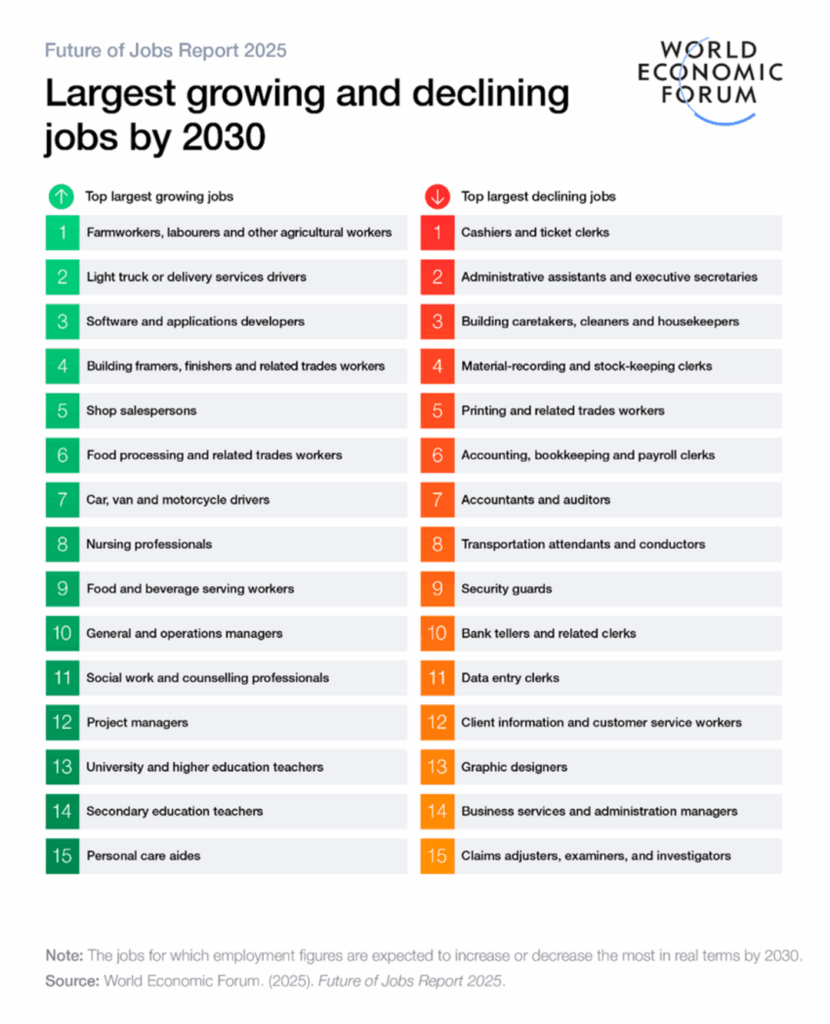
This divergence illustrates why cognitive skills matter across all job categories. Nearly every growing role, whether technical, essential, or human-centered, now depends on capabilities AI cannot fully replicate. Employers increasingly value workers who can interpret complex situations, exercise sound judgment, adapt to unfamiliar challenges, empathize with others, and solve problems creatively. These cognitive abilities form the foundation of long-term employability, allowing individuals to shift across industries, learn new tools, and stay relevant as work continues to evolve.
Why Cognitive Skills Matter Across All Job Categories
Automation is reshaping the tasks people perform, shifting human work toward what requires deeper thinking. Analytical reasoning enables workers to interpret information, solve novel problems, and make decisions in uncertain environments. Creative thinking supports innovation in both technical and human-centered roles. Resilience and flexibility help workers cope with new technologies, shifting expectations, and economic volatility.
Whether someone becomes a nurse, a renewable-energy engineer, a software developer, a teacher, or a logistics manager, these cognitive abilities underpin success in every profession.
For young people entering the workforce, these skills form the foundation of every career transition they will make. For adults already in their careers, cognitive agility determines how effectively they can adapt, retrain, and stay relevant.
Upskilling and Reskilling: A Global Priority
One of the clearest messages from the Future of Jobs Report 2025 is the scale of training required over the next decade. According to the report, if the global workforce were represented by 100 people, 59 would need reskilling or upskilling by 2030 – and 11 of them are unlikely to receive the training they need. This gap places more than 120 million workers at medium-term risk of redundancy.
As AI accelerates and job structures continue to shift, employers are intensifying their focus on developing adaptable, cognitively strong workforces able to learn new tools and navigate evolving environments.
Demographic Shifts and the Rising Demand for Cognitive Skills
Demographic change is reshaping global labour demand. Aging populations increase the need for healthcare workers, while expanding youth populations in other regions drive demand for teachers and educators.
These pressures amplify the importance of cognitive and interpersonal skills – such as motivation, teaching, mentoring, talent management, and social influence. As workplaces become more complex, the ability to communicate effectively, adapt to different learning needs, and operate within diverse environments becomes increasingly essential.
Cognitive abilities form the foundation of these capacities. They influence how individuals process information, respond to changing demands, and manage complex social or educational situations.
In this landscape, digital tools that support cognitive assessment and structured cognitive training can be particularly valuable. CogniFit provides dedicated platforms for different professional settings – an educational platform that allows teachers and institutions to work with students on cognitive development, and a health-professional platform designed to help clinicians monitor and assess cognitive profiles in their patients. These tools offer structured ways to understand cognitive strengths and challenges, supporting professionals as they navigate the growing demands created by demographic shifts.
Why Cognitive Skills Training Should Begin Early
The pace of technological and economic change means that cognitive development is no longer just a developmental milestone – it is a strategic advantage.
Children who build strong reasoning, memory, attention, and cognitive flexibility early in life have an easier time learning new technologies, adjusting to change, and acquiring new skills later on. The report emphasises curiosity and lifelong learning as essential qualities for future workers.
Developing cognitive capabilities early helps build the foundation for continuous learning and long-term adaptability.
The Role of CogniFit in the Future Skills Landscape
Platforms like CogniFit, which specialise in cognitive assessment and brain-training programs, align closely with the skills highlighted in the Future of Jobs Report.
CogniFit provides tools that help individuals understand their cognitive strengths and challenges, and offers training programs that support:
- Reasoning;
- Memory;
- Attention;
- Cognitive flexibility;
- Processing speed;
- Planning and others (more than 23 cognitive abilities in total).
For families thinking about the future of their children, CogniFit offers an accessible way to begin strengthening mental agility early. For adults, it provides opportunities to reinforce cognitive foundations that support career adaptability and continuous learning.
To explore cognitive assessment and training options, visit www.cognifit.com.
A Changing World Demands a New Approach to Learning
Workforce transformation isn’t coming someday in the future – it’s happening right now. Technology is accelerating, populations are shifting, and industries are being reshaped by forces that move faster than any of us can fully track.
In a world like this, cognitive abilities become the closest thing to solid ground. They help us learn new tools, adapt to unfamiliar situations, stay resilient under pressure, think creatively when routines stop working, and make thoughtful decisions when the world feels unpredictable.
In the years ahead, the people who thrive will be those who can adjust quickly, stay curious, and continue learning long after their formal education ends. That’s why cognitive fitness is no longer just a personal advantage – it’s becoming one of the most practical foundations for navigating a changing world with confidence.
The information in this article is provided for informational purposes only and is not medical advice. For medical advice, please consult your doctor.